Tell Marrow in the corridor, and the person is filed before you reach the lift
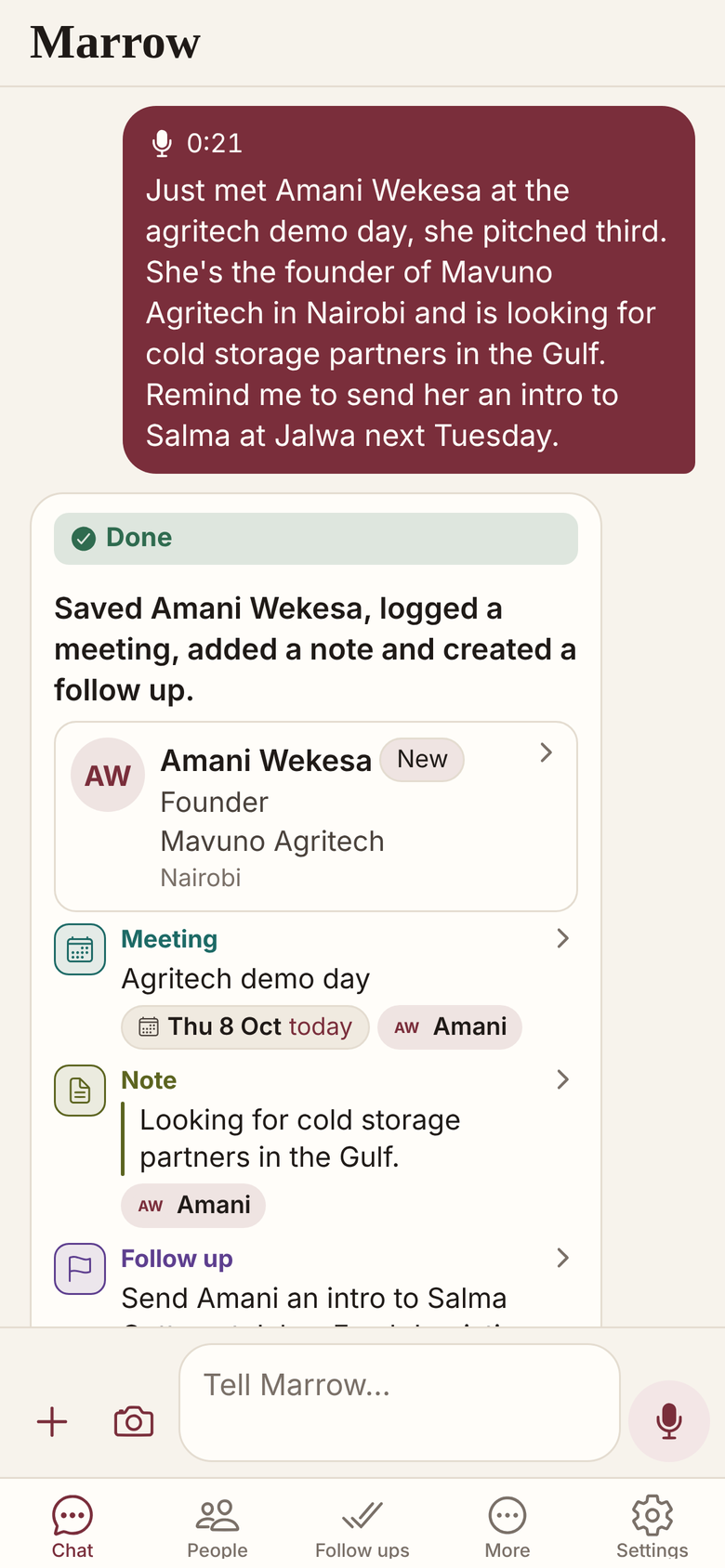
Because the minute after a meeting is when you remember the most and have the least time. Marrow takes whatever you have then, a voice note, a photo of a card, a screenshot or a typed line, and files the person, the context and the follow up.
Capture in Marrow is a conversation because of when capture happens: in the corridor, the lift or the taxi, a minute after you shook someone’s hand. A form asks for fields in its order. A chat takes what you have, in yours. Marrow is in Beta.
The minute after a meeting is the one that counts
You have a card in one hand and your phone in the other, and somebody is already waiting to talk to you. What you know about the person is vivid for a few minutes: what they need, what you promised, who they should meet.
A contact form wants a given name in one box, a family name in the next, then a company, a role and a labelled phone. At the bottom sits a notes field that is easy to leave empty. It records the contact and can lose the conversation.
The quick alternatives are a card left in the camera roll, a line sent to yourself, or a promise to write it up tonight. Those are what Marrow really competes with, and each keeps the moment but can drop the follow up.
Four ways in, one place they land
| What you have | What you send | What Marrow files |
|---|---|---|
| A thought, while walking | A voice note: hold to record and release to send, or tap to record hands free | The transcript in the bubble, the person, what you said about them, and a follow up if you named one |
| A business card or a badge | A photo from the camera button | A person with name, role, company, email, each phone with its label, website and address |
| An email or chat thread | A screenshot | Everyone in the thread, the thread logged once with its date and a short summary, and a follow up for a dated promise |
| A line of text | “remind me to send Tariq the revised contract next Wednesday” | A follow up on the right Wednesday, with the date worked out in code |
The reply is where you check the work
A capture ends with a reply that says what was saved, so a misheard name or a wrong date shows while you still remember the right one. You correct it in a line in the chat, or in the person’s editor.
When Marrow cannot read a card well, it asks rather than guessing, such as “I could not read that properly. Is the name Hana Petrosyan?” Dates are computed in code from what you said, so next Tuesday means the Tuesday on your calendar.
The same chat answers questions
Because everything went in through one conversation, you ask for it back the same way. “Prep me for Salma Qattan”, “who do I know at Jalwa Fresh Logistics”, “what is due” and “who is going quiet” are answered from your own record.
The chat also drafts a message when you ask. The draft says it was not sent, and you copy it when it reads right. Marrow does not send messages on your behalf.
There is a form, behind the chat
The People tab has an editor for a person’s fields, from phones with labels to how you met and a birthday. It is for corrections and for the details you want to set yourself. The front door is the chat, and content shared from another app lands there as a draft marked “Shared with Marrow”.
Where this fits, and where it does not
Talking to Marrow suits people who meet many new people and are judged on whether they follow up. If you like typing every field yourself as you go, a contacts app may serve you just as well.
Marrow is one person with one record, with no shared workspace and no sales pipeline. A deal has a title, a status and a timeline.
Related
Get Marrow on your phone.
Install the app, sign in with your email, and send it the last business card you are still carrying. Marrow is in Beta.