Walk in knowing last time, what changed and what you want, in five minutes
For a meeting with one person, spend two minutes on what happened last time and what was promised, two on what has changed at their company, and one on the single outcome you want. Everything else is optional.
A meeting you have had before needs memory more than research. You need to remember the last conversation, know what has changed, and be clear about what you want from this one.
Minutes one and two: the history
- What was discussed last time, in one line.
- What you promised, and whether you delivered it. If you did not, open with that.
- What they promised, and whether it arrived.
- Who else from their side was involved.
If you cannot answer these, search your sent messages and your notes before anything else.
Minutes three and four: what changed
- Any announcement, funding, appointment or product news at their company.
- Any change in their own role.
- Anything public they have said recently that touches your conversation.
Two sources are enough: their company’s news page and their own public profile. Do not arrive with a dossier; arrive with one informed question.
Minute five: the outcome
Write one sentence: “I want to leave with X.” A date, a decision, an introduction, an answer. If you cannot write that sentence, consider whether the meeting should be a message instead.
A worked example
You are meeting Ravindra Pillai, Director of Procurement at Kavach Pharma Distribution, on a video call at 15:00. You met him at the supply chain panel in Riyadh. Five minutes produce this:
| Question | Answer |
|---|---|
| Last time, in one line | He wants temperature logging for vaccine shipments across the Gulf |
| What I promised | An introduction to a cold chain operator; I sent Salma Qattan’s details, delivered |
| What he promised | The timeline for their logistics tender; not received yet |
| Who else was involved | Nobody from his side |
| What changed | Kavach announced a new warehouse in Chennai last week |
| One informed question | Does the new warehouse change where the tender starts? |
| The outcome I want | The tender timeline, and a date for the next step |
You open by confirming the introduction landed, ask your question, and close on his outstanding promise without making it awkward.
The checklist
- Last conversation, in one line.
- Promises made, in both directions, and their status.
- One thing that changed at their company.
- One informed question.
- One desired outcome, written as a sentence.
If you have forgotten who they are
Do not fake it. Open with a short, honest frame: “Before we start, remind me where we left off so I do not repeat myself.” After the meeting, note what was agreed, what you promised and by when. That note is the history for next time.
Where Marrow fits
Marrow is an app on iPhone and Android. Ask it “prep me for Ravindra” and it answers from your own record: how you met, when you last spoke, what you owe him and your personal notes. If Marrow has no recent brief of his company, asking also runs a company lookup for its news, and that counts as one lookup. It adds a heads up when the relationship has gone quiet.
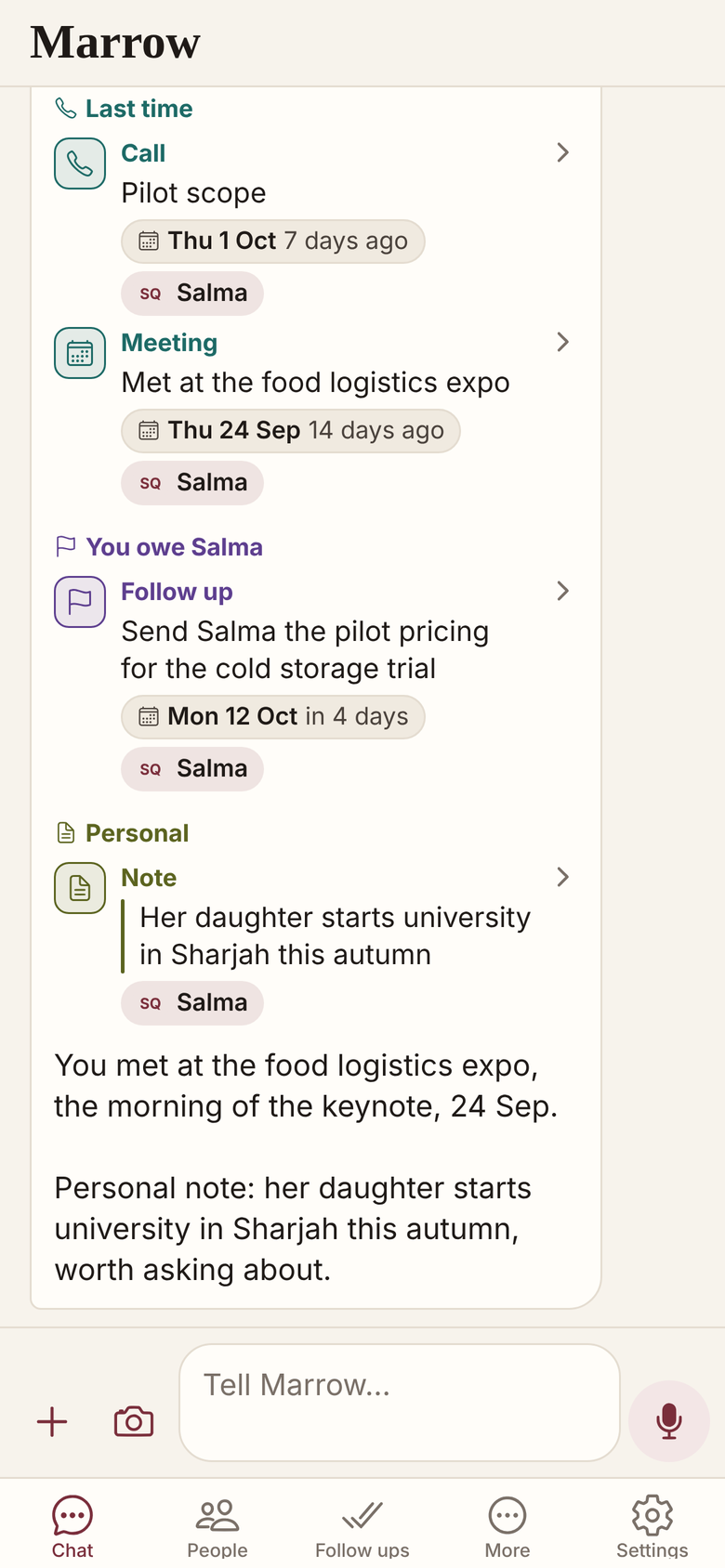
The brief comes when you ask for it, and nothing arrives on its own ahead of a meeting. After the call, a voice note with what was agreed becomes the history for next time, and any promise in it becomes a follow up with a date. Marrow is in Beta.
Who should not bother: if you have a few meetings a week with people you know well, a five line note per person works. If your meetings are mostly with your own team, this is not the problem you have.
Related
- Guides
- How to remember names and details
- Reconnecting after a long silence
- How to follow up after a conference
Get Marrow on your phone.
Install the app, sign in with your email, and send it the last business card you are still carrying. Marrow is in Beta.