Name the gap in one clause, give a real reason, and ask for nothing
Recover what you knew about them, find a real reason to write, and send a short message that names the gap in one clause, offers something specific and makes it easy not to reply. Do not open with a favour.
The silence can feel larger to you than to them. The work is in finding the reason and the context before you write a word.
Step one: decide whether to write
Ask whether you would be glad if they wrote to you. If the answer is yes, write. If the relationship ended badly, or you are writing because you need something tomorrow, wait until you have a better reason.
Step two: recover the context
Before writing, find out what you knew.
- Search your email and messages for their name, and read the last thread to the end.
- Check your notes, your calendar for the week you met, and your camera roll.
- Look at their public profile and their company’s news. Roles change, and you do not want to congratulate them on a job they left.
- Find what was open: a promise you did not keep, a question you did not answer.
If you owed them something, the message starts there. “I said I would send you the shading study and did not” is a better opening than anything clever.
Step three: find a real reason
Good reasons, roughly in order of how welcome they are:
- Something useful for them. An introduction, a lead, an answer to a question they once asked.
- Their news. A new role, a launch, a move, a piece of work you saw.
- A connection to your news. Something you are doing now that touches what they care about.
- A specific memory. You were reminded of something they said.
“It has been too long” is not a reason on its own. It is the clause you put in front of one.
Step four: write the message
Four parts, short enough for a phone screen.
- The gap, in one clause. “It has been a while since the biennale.”
- The reason you are writing now.
- Something specific: the useful thing, or one real question.
- An easy out. “No need to reply if you are buried.”
Three that work, built differently. The useful thing, for an architect met at the urban design biennale:
Hana, it has been a long time since the biennale. A school group I advise is looking for an architect who understands heat on open courtyards, and I remembered your campus work. Would you like me to introduce you? No pressure if the timing is wrong.
Their news, for a lawyer met at a conference dinner:
Tariq, I saw that Marsa Legal has opened a charter disputes practice, congratulations. We talked about exactly this over dinner after the maritime law conference. I hope it is going well, and I would be glad to hear how it started.
A specific memory and a question, for an editor:
Daria, after the panel you told me regional trade routes would be the story of the decade. Are you still covering it at Signal Hill Media? I have a contact you might want to speak to.
What not to do
- Ask for a favour in the opening message. Reconnect now, ask later.
- Apologise at length. One clause is gracious; a paragraph is about you.
- Invent a reason. “I was just thinking about you” with nothing behind it reads like a mass message.
- Send the same note to a dozen people from the same old event.
After you send it
If they reply, suggest a small next step, such as a short call. If they do not, let it rest, and write again when there is real news. For more wording, see the long silence templates.
Where Marrow fits
The hard part of reconnecting is the context, and context is what Marrow keeps. It is an app on iPhone and Android. Ask “prep me for Hana” or “what do I know about Hana” and it answers from your own record: how you met, what was said, what was left open. Either question also runs a company lookup for her company’s public side when Marrow has no recent brief of it, and that counts against your plan.
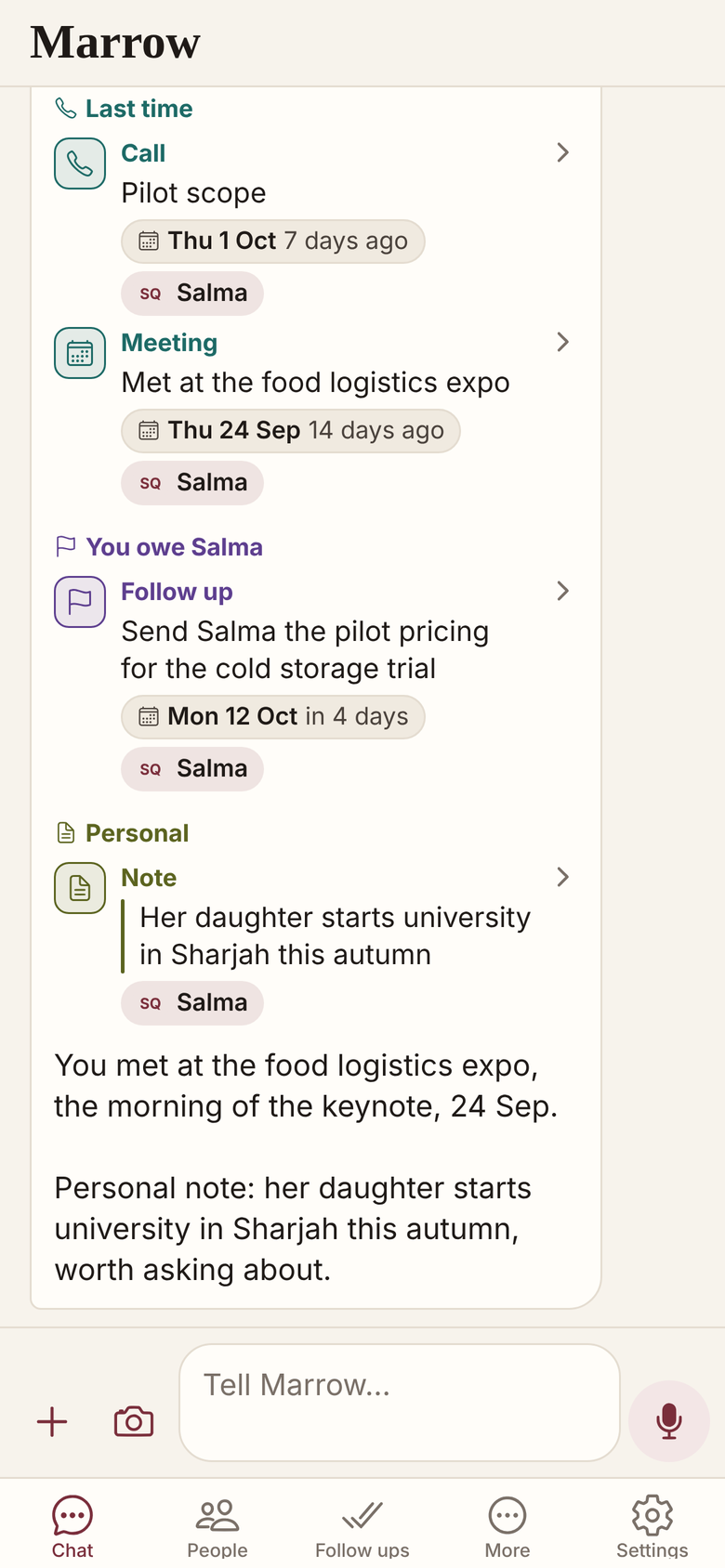
The daily brief lists who is going quiet, and Marrow can draft the message for you to edit, marked not sent. You send it yourself, because Marrow does not send messages on your behalf. Marrow is in Beta.
Who should not bother: if the old email thread holds the context you need, your inbox is enough. Marrow does not read your mailbox, so to give it an old thread, send a screenshot of it.
Related
- Guides
- Keep in touch cadence
- Five minute meeting preparation
- Follow up messages after a long silence
Get Marrow on your phone.
Install the app, sign in with your email, and send it the last business card you are still carrying. Marrow is in Beta.