Three follow up drafts from four short answers, built in your browser
Fill in who you met, where, what you talked about and what you promised, pick a tone and a length, and you get three drafts built in different orders. The drafts are assembled from fixed templates in your browser, and nothing you type is sent anywhere.
Four short answers and three choices give you three drafts to copy, edit and send. Each draft puts the facts in a different order, and a short draft may leave one out, so pick the one that sounds like you.
The drafts are assembled from templates in your browser. Nothing you type is sent anywhere or stored, and no model writes them.
How the drafts are built
There is no model behind this page and no server. The page holds a fixed set of sentences for each language and tone, and fills in your words. Change any answer and the drafts change with it.
- Draft one opens with where you met, then what you discussed, then the promise. It suits someone who met a lot of people that day.
- Draft two opens with the promise. It suits a message that carries something: the deck, the introduction, the price.
- Draft three opens with a question. In the warm tone it asks about what you discussed and then asks for a call; in the formal tone the opening question is the request for a call. It suits a contact you want to move forward.
Short keeps to the core sentences and can leave one of your answers out. Medium uses every answer and adds a sentence or two, such as an offer to talk, and a sign off. The Arabic drafts are warm in an everyday Levantine register and formal in Modern Standard Arabic; if you speak another dialect, pick the formal draft or change the few words that are not yours before you send it. They address the reader in a form that reads the same for a man or a woman.
Getting a good draft out of it
- Be specific about the discussion. “Cold storage for the new warehouse” makes a better line than “logistics”.
- Write the promise as a verb. “Send you the pilot pricing” fits every template; “pricing” does not.
- Write the name as you would say it. A first name for warm, a title and surname for formal.
- Edit before you send. A template cannot know what the person said that mattered most; one sentence of your own makes the message theirs.
Where Marrow fits
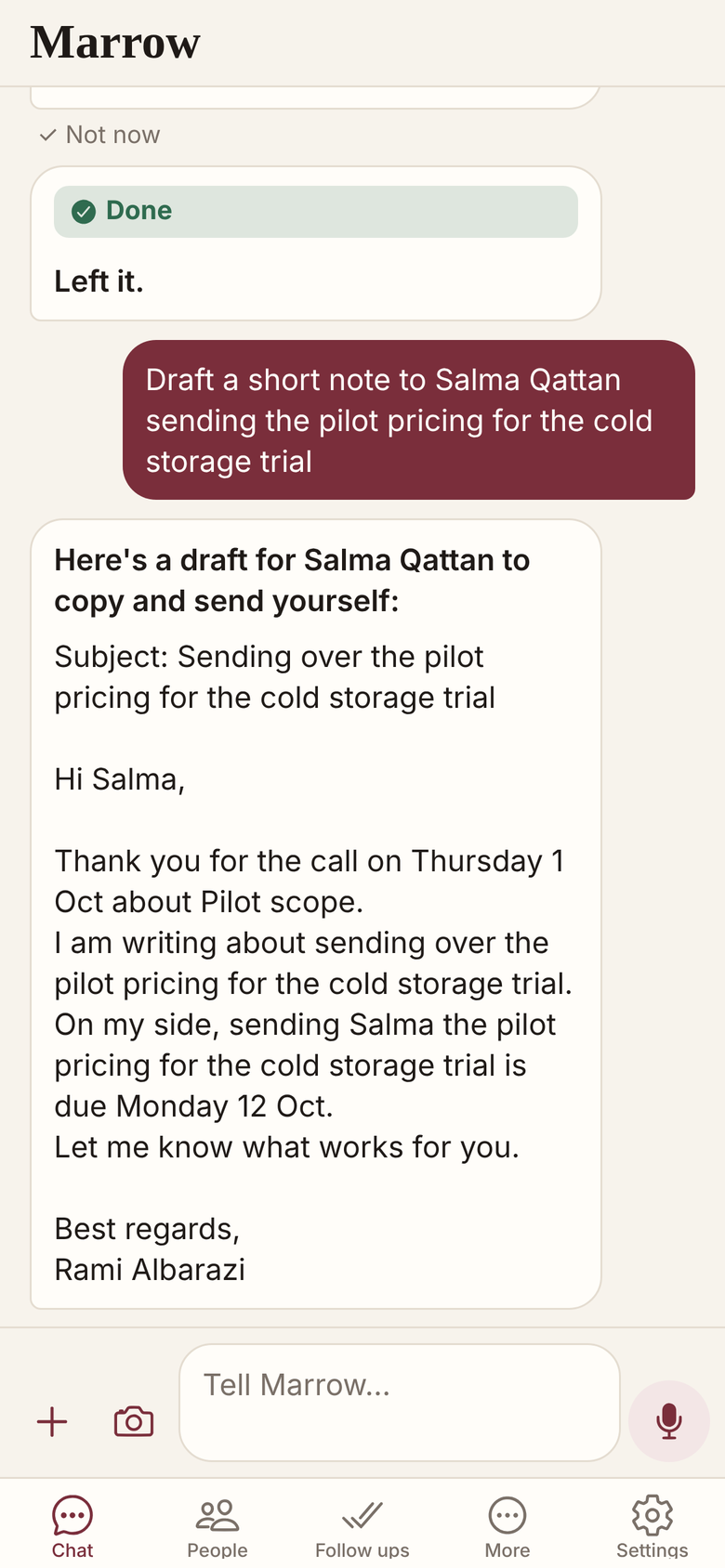
The Marrow app does more: it drafts from what you told it about the person, and it files what you said, the context and the follow up with its date. You send the draft yourself. Marrow is in Beta. This writer is for people who do not want an app: it is free, needs no account and keeps nothing.
Related
Get Marrow on your phone.
Install the app, sign in with your email, and send it the last business card you are still carrying. Marrow is in Beta.